
🏋️♀️ Can Lifting Weights Help You Live Longer? Here's What the Science Says
A huge piece of research, involving over 147,000 participants, tracked for up to 30 years, has just given us some of the strongest evidence yet that lifting weights doesn't just make you stronger - it could actually help you live longer!
Let me break it down for you in plain English. No jargon. Just facts.
What Did the Study Actually Find?
The research, which was covered by the BBC and published in the British Journal of Sports Medicine, found that people who did between 90 minutes and two hours of resistance training per week had a 13% lower risk of dying from any cause compared to people who did none.
That's not a small number. And it's not just "live longer in theory" either. The study found meaningful reductions in risk across some of the biggest health concerns out there
Heart disease — up to 19% lower risk of dying from cardiovascular causes
Neurological conditions (including dementia) — 27% lower risk
Cancer — some reduction in risk, particularly at lower doses of training
And here's the bit that really got me and my co-host Katie Bulmer-Cooke buzzing when we discussed it on The Voice of Fitness Reason podcast - when you combine strength training with regular aerobic exercise like walking, cycling or running, the most active people saw their risk of early death from any cause fall by up to 58%.
Fifty-eight percent. That is wild.
Why This Matters More Than You Think
For years, most of the big headlines around exercise have focused on cardio. And cardio is great, genuinely, but strength training has been a bit of an underdog when it comes to the research.
This study changes that. It gives us solid, long-term evidence that picking up weights regularly, consistently, with a bit of effort, has a direct impact on how long and how well you live.
All you need is 90 minutes a week.
That could be:
Three 30 minute sessions
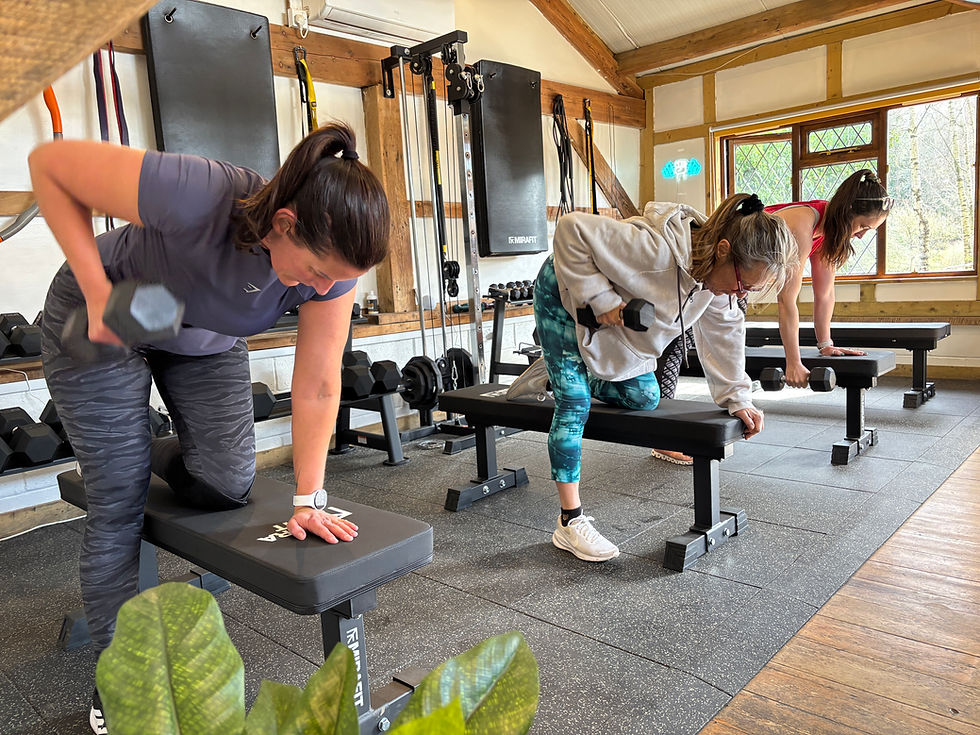
Two 45 minute sessions (...like our barn sessions!)
A 20-minute home workout five days a week (...hello YouTube!)
It's doable. For most people.
One more thing worth noting: the study found no additional benefit beyond about two hours a week. So you don't need to be spending hours in the gym every day. You just need to be consistent with the time you do put in.
"Okay Frank, But What Should I Actually Do?"
This is where it gets practical. The study didn't tell us what the strength training looked like, just that people were doing it. So here's what I'd tell any of my clients, whether they train with me in the barn or follow along with my home workouts online.
1. You've got to actually challenge yourself.
There's a difference between going through the motions and genuinely working. If you're picking up the same light weight and it feels easy every single time, your body isn't being asked to do anything new. Progress comes from effort. That doesn't mean you have to be grimacing on the floor — but by the last few reps of a set, it should feel genuinely hard. Good hard. "I'm not sure I've got another one in me" hard.
2. Start with the big movements.
If you're new to this, don't overthink it. Focus on compound exercises — movements that use more than one joint and work multiple muscle groups at once. Think squats, deadlifts, press-ups, rows. These give you the biggest bang for your buck, especially if your time is limited.
I actually put together a free 5 Day Strength Kickstart on YouTube for exactly this reason. Five days, five foundational movements, follow-along style so you don't have to think too hard. Just show up and do it.
3. Progress over time.
Once the basics feel familiar, start increasing the challenge — a heavier weight, more sets, fewer reps. Your body adapts quickly, which means what felt hard in week one will feel easy in week four. That's a good sign. It means it's time to push a bit more.
4. It's never too late to start.
One of my favourite clients started strength training at 62. One year later, she's showing off her biceps and telling me her gardening, her travelling, and her everyday life feel easier than they have in years. That is everything. The external stuff is nice, but it's the internal changes — the energy, the strength, the confidence — that really matter.
You Can Actually Buy Yourself Time
Katie said something on the podcast that's stuck with me:
"The one thing people always say you can't buy is time. But actually, this study is suggesting you can."
You can spend time and energy now, in exchange for more of both later. That's not a bad deal. That's arguably the best deal going, and unlike a lot of things that promise results, this doesn't have to cost you much.
If you've got a body, you can strength train.
You can do it at home, in a gym, or, if you fancy it, in a barn in Surrey with me. 😄
Ready to Start?
If you've been thinking about getting into strength training but don't know where to begin, start here:
Five days. Follow-along videos. No equipment needed to get started. Just you, a bit of space, and the willingness to show up.
Hope it helps.
FRANK
your Personal Trainer / Life Extender
___________
Frank is an award-winning personal trainer based in Surrey, UK. He trains clients in person at Priory Farm and online through his follow-along home workout videos. Find him at fitwithfrank.com and on Social Media (@fitwithfrank).


